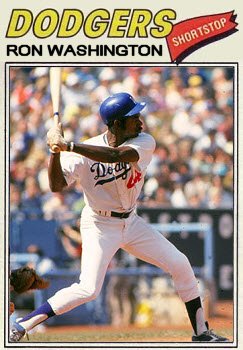
It had been 8 seasons since MLB expanded and the AL granted 1 team to Seattle and another to Toronto. The Blue Jays chose Roy Hartsfield as their first skipper and away they went to the expansion draft, which was filled with a veritible who's who of has beens, never was'es, misfits and malcontents. Most expansion teams are destined for the basement due to little or no pitching plus a weak supporting cast. Finishing dead last with a 54-107 record was par for the course for a team like this. Topps once again had trouble handling expansion. Like they did 8 years earlier when the league added 4 teams, Topps dipped heavily into their airbrush. To their credit they stayed away from the BHNH look, which they used as a preemtive strike for players they suspected would be left unprotected. Topps also did some neat art work for Toronto's airbrushed cards. Seattle's cards were a certifiable disaster, which is a story for another day. Topps would have been ok if it were not for the good folks at O Pee Chee. The Canadian card company, which licensed Topps' cards and photos decided to head down to spring training and get pictures of a many new Blue Jays as possible. This gave the fans up in Canada a great set of innaugrual Blue Jay cards and made the folks here in the states feel like we got short changed. This updated set includes the scarce O Pee Chee cards, which will be duly noted and the updated cards that I created. 36 additional cards were added here.

Torres played in 91 games and hit .241 and never played again in the majors after the curtain came down on the '77 season. In 9 seasons he managed to hit .216, which means that '77 was a career year for him. Basically he peaked and then he was done. For this card I used a 8x10 glossy photo found on auction on ebay. I've been tracking the auction in hopes of finding out just what type of person would spend their hard earned money on such an item.

Byrd started 17 games and had a 2-13 record with a 6.13 ERA. No one was shocked that after the season he got "farmed out" and never again returned to the majors. This photo is from his 1978 Topps card.

Garvin was one of Toronto's front line starters. His 10-18 record and 4.19 ERA was pretty impressive when considering who he had playing behind him. He would spend 6 total seasons up in Toronto before being sold to St. Louis, then cut. This card was update in April 2017 when reader
Jym E. Changa noticed that we used a mis-labled Tom Murphy photo. The updated photo comes from eBay.

After 9 seasons in the "biggs" Johnson was left unprotected by the Padres. His best season was in 1971 where he was 12-9, 2.97 for the 1st place NL West SF Giants. He even garnered 6th place in the Cy Young Award voting even though he didn't start a single game that season, which was a rarity back then. After that magical season his ERA steadily ballooned as his effectiveness declined. He pitched in 43 games, all in relief, for the Jays in '77 and had a 2-4 record. He was cut in spring training the following season, which marked the end of his major league career. This card was created by cropping his 1978 Topps card photo.

Clancy was one of those rare guys, who join an expansion team and stick with them as they grow into contention. All in all he spent 12 seasons up in Toronto and was able to experience the highs (making the playoffs in '85) and the lows (chocking in the final weekend in '87). Still, he came to Toronto as a 21 year old looking for a break and left in 1988 as a 12 year veteran who had seen it all. In '77 he would start 13 games and go 4-9 with a 5.05 ERA. Someone saw something in his right arm, because unlike others who were left by the roadside he was brought back and steadily improved. This card was created using his 1978 Topps card photo. I had to airbrush in more seats in the upper deck of Yankee Stadium to cover up the "position ball" that Topps superimposed on all cards in '78. Some '78 cards were easier to do this with, while other were tougher.

In over 230 AB's Scott hit .240 with only 2 home runs, which is not exactly the statline you'd like to see for a corner outfielder. The Padres had him up for 2 cups of Joe at the end of the 74 and 75 seasons. He didn't even see big league action in 76. After the '77 season he was dealt to the Cardinals along with Vuckovich, but never saw any action in the big leagues. I used his 1978 Topps card and had to do so neat airbrushing. If you look closely you'll notice the bat isn't exactly shaped perfectly. I had to do a gradual airbrush build on it to cover over the position ball on the '78 card.

Wills was "snatched" out of the pitching rich Orioles chain, where he never even got a shot at the big leagues. Drafted in 1968, he spent 9 seasons toiling in obscurity befor expansion saved his baseball soul. Used primarily out of the pen in '77 for Toronto Willis aquited himself quite well with a 2-6 record and a 3.94 ERA. He would pitch 4 more seasons in Toronto before calling it a day.

By the time Fairly arrived in Toronto he was heading into the final years of a solid and sometimes spectacular career. 1977 would mark Farily's 20th major league campaign. Below average players do not last that long. Not only was he an "original Blue Jay", but back in 1969 he was an "original Expo", which means he was one of the first MLB'er to play for both Canadian franchises. Fairly didn't just collect a paycheck in Toronto. At the age of 38 he was the Blue Jays' best every day player sporting at .279 with 19 homers and 64 RBI's. The 19 homers turned out to be his career high. Fairly's 12 seasons in Los Angeles were very rewarding. He won 3 World Championships and 4 pennants in his first 8 seasons as a guy who played both 1st and all 3 outfield positions. At the end of the season he was dealt to the Angels as a reward for being such a good soldier with the Expansion Blue Jays. He would retire after that season and finish with a .266 career average and over 225 homers. The photo here was taken from his '78 Topps Card.

On May 9th, 1977 the Blue Jays stole Howell right out from under Texas' nose. For the poulty price of one broken down Steve Hargan and one hitless Jim Mason the Jays were able to get themselves a .313 hitter, who also hit 10 homers. In '78 he would actually make the All-Star team. Howell would spend 4 above average seasons in Toronto before signing in 1981 with the Brewers as a free agent. In '77 he would lead the Blue Jays in batting average, while playing a solid third. This card was created using his '78 Topps card photo.

Ewing tooled around the White Sox chain since 1971 and got two cups of coffee (1974 & 1976) up with the big club. His .197 average and spotty play didn't impress anyone, so he was left available for the expansion draft. Toronto looked like a bunch of geniuses when Ewing hit .287 with 4 homers and 34 RBI's while manning both corner OF slots and first base. He appeared in 97 games and had 244 AB's. At 28, he was now an overnight sensation, but it all came crashing down the following season when he hit .179 in 40 games and wound up back in the minors for good. Eventually he would head to Japan and play for the Nippon Ham Fighters, who I guess had some sort of kosher agenda that they were attempting to spread to baseball. Anyway, this card was created with the photo from his '78 Topps card. I had to do some airbrushing in the top right to get rid of the position ball by replacing it with some clouds.

I spent the better part of 2 years trying to find a good photo of Steve Bowling. First I needed one for an Expansion team tournament, then I needed one for KOD season where we played teams that lost over 100 games. As hard as I searched I found nothing, but a grainy minor league photo on ebay. Then by accident I stumbled on this one. Apparently someone on ebay is selling his game worn Blue Jays jacket from 1977. This picture was a Black and White postage stamp sized photo from a media guide. I immediately decided to colorize it and "stuff" it into a card. There was no margin for error, since the photo was limited to this tight head shot view. Topps was famous for issuing at least 10-15 of these types of shots each year, so this fit in rather well with the set. Bowling as a player was nothing to write home (or a blog) about. He played all 3 OF spots and hit .206 with 1 homer in almost 200AB's. It was no shock that he was not invited back to Toronto for the '78 season.

Staggs played in 72 games for Toronto and hit just a tad under .260 and played a credible 2nd base. He is listed as Toronto's starting second baseman on baseball-reference.com and rightfully so, since he logged the most games at the position. After the season, Toronto must have known that he was a valuable trade commodity, so they dealt him to the A's for the ever so memorable Sheldon Mallory, who never found his way north to the big club in Toronto. Staggs played just 1 season with Oakland and wound up on the scrap heap himself. This card was also created using his '78 Topps card. It was a pain in the neck to airbrush the position ball out because the background was the grandstand. I tried to copy and paste some people in, but if you look closely you'll see it wasn't a grade "A" job, but definitely well within Topps' limits for that era.

Nordbrook was one of those guys who bounded around from organization to organization hoping to catch on as a utility guy. After stints with the Orioles, Angels and Chisox he was sold by the latter to Toronto in August where he got into 28 games and hit .175. Still the Blue Jays brought him back for an encore in 1978. That encore lasted 7 games before he was shipped over to the Brewers for Tim Johnson. This photo comes from his '78 card. I had to airbrush parts of the upper deck in Yankee Stadium, where the photo was taken, back into the card to cover the position dot.

Midway through the '77 season the Bosox sold "Murph" to the Blue Jays for some Maple Leafs tickets and a couple of bottles of Molson XXX. Quite possibly the Blue Jays got the better part of the deal, because Murph spent the next 2 + seasons anchoring a shaky Toronto bullpen. In his 19 games in a Blue Jay uni in '77 he was 2-1 with a 3.63 ERA + he logged 52 innings, which might be his most valuable stat of the year. As we all know logging innings on an expansion club is very important. Murph was no career minor leaguer like a lot of the Blue Jay staff. He had a 9 year resume in the AL and sported a 10-10 record with a 1.93 ERA in 1974 while toiling with the Twins. In his early years with the Angels he was a back end starter who regularly logged 200+ innings. After starting the 1979 season with a 1-2 record and a 5.40 ERA Murphy was released, and so ended a mediocre MLB career that touted a 68-101 record with a 3.78 ERA. Obviously those poor Angel teams failed to score runs for him and that hurt his career record. This card was created using his '79 Topps card.

Bill Singer arrived at Spring Training in 1977 as a 33 year old veteran pitcher with arm trouble. He was worth the risk for the Blue Jays, because any time you can get your hands on a two time 20 game winner / All-Star you do it. If Singer righted his ship the Blue Jays would surely deal him to a contender for future prospects, which could help both clubs. Unfortunately that fairy tale story was not going to be written. In 13 starts Singer would finish 2-8 with a 6.79 ERA. He would spend more time on the DL than on the field and by spring training of 1978 he was given his release. He finished his career with a 118-127 record and a sparkling 3.39 ERA. Some folks in the HOF have a higher career ERA than Singer, who never got much run support playing for the light hitting Dodgers of the 1960's and Angels of the 70's. One can only imagine how good his record would have been if he played in Cincy or Pittsburgh during that era. This card was created using a rare 8x10 signed glossy shot that I found on an ebay auction. All that needed to be done was a quick resizing.

The 24 year old Debarr got into 14 games for the Blue Jays in '77 and finished 0-1 with a 5.91 ERA. After tooling around in the Tiger organization for the better part of the last 5 or 6 years he was drafted by the Jays. He spent time shuttling back and forth between the big club and their minor league affiliate in Syracuse. During spring training of '78 he was dealt to Cleveland for the taciturn Rico Carty who actually had a breakout year at the plate for Toronto as their regular DH. The picture used here was a minor league Black and White card that I colorized, added the Toronto logo and cropped extensively. Debarr looks unhappy in this photo and who can blame him, since I didn't exactly do a Disney type colorization of him.

The "Red Rooster" was a 5 time gold glove winner at third base for the Houston Astros during the early 1970's. By 1977 he was 33 going on 44. Never a big hitter for average, Rader still could supply 20+ homers while playing in the cavernous Astrodome. By the late 70's his average was dropping as well as his power numbers. His range at 3rd, which was his trademark, was also not as good as it used to be. After hitting .223 in 1975 the Astros shipped him to San Diego, where he bounced back to a more customary .257. By mid season 1977 he was actually hitting in the .270's for the Padres, but his range in the field was gone and his bat had no pop. Toronto took a flyer on him and purchased his contract from the Padres. He found his power stroke again and hit 13 homers in 96 games, but his average dipped to .240. The Blue Jays released him in spring training the following year and that marked the end of a solid career. This card was created using a player photo found while searching Google.

Bailor turned out to be one of those "diamond in the roughs" that just never got a chance while being buried in the Orioles farm system behind guys like Belanger, Dave Johnson and Grich. Arriving in Toronto turned into a new lease on life. He hit .310 in 122 games and played just about every position on the field. He would have 4 more decent seasons for the Jays before being traded to the Mets for Roy Lee Jackson in December of 1980. He would go on to have some good seasons with the Mets and Dodgers before ending an 11 year career that might never have occurred if it wasn't for expansion. This card was created using his '79 Topps card photo.

With Carlton Fisk firmly entrenched as the Red Sox staring catcher and Bo Diaz ahead of him on the depth charts, Whitt was deamed expendable and the Jays chose him in the '77 expansion draft. After two cups of coffee in Toronto he was farmed out in '79, which looked like for the final time. Apparently lefty hitting catchers are valuable commodities and so the Jays didn't give up on Whitt. In 1980 he returned to the biggs and never left. For the next 10 years he was the starting catcher on a contending Blue Jay team. He hit over 150 homers during that stretch and can arguably be called "the best catcher in Blue Jays history". As for 1977 he batted .171 in 23 games behind the plate, so don't expect much. For this card I used his 1978 rookie panel card, which isn't the best of quality, but it conveys just how much of a suspect as opposed to a prospect that Whitt was during that era.

The "Italian Stallion", as he became know to Yankee fans in the early 80's, found his way to Toronto via trade. The Indians sent him and John Lowenstein to Toronto right after the expansion draft, in exchange for Rico Carty. Cerone, an All-American at Seton Hall, would catch 31 games and hit an even .200 for the Blue Jays during their inaugural year. He would log even more time in '78 and '78 before being traded to New York in a big 6 player deal that saw Chris Chambliss and Damaso Garcia head to Toronto. Cerone had a breakout year in 1980 as Thurman Munson's replacement (like anyone can replace Munson ?), but success came at a high price as he fell out of favor quickly with Yankee fans when he wasn't able to duplicate his early success. Still he cobbled together a fine 18 year career as a backstop. This is actually his O Pee Chee Card from 1977. I decided to use this one because I loved the way O Pee Chee airbrushed on a cap that looks like a college pledge hat atop Cerone's fro.

Bruno would pitch 18 innings and compile an 7.85 ERA for the '77 Jays, which was only marginally worse than his 1976 stats in KC. The Cardinals must have seen something in him, because they dealt Rick Bosetti and cash to acquire him the following season. Bruno rewarded the Cards with a 4-3 record and a 1.99 ERA. At the age of 25 he looked to be on his way and Toronto looked to be kicking themselves in the arse for letting him slip away. The following year his ERA ballooned back up again and just like that he was gone from baseball. Call him a 1 hit wonder. This is his O Pee Chee card, which was taken during spring training. The good folks at O Pee Chee avoided he airbrush and decided to take the road trip unlike the lazy slugs with crayons over at 1 Whitehall Street (Topps' office in NYC).

Somehow the Twins just didn't see the signs that Woods was going to be a really good player in the majors. For 5 seasons he tooled around their farm system until someone decided to make him available for the expansion draft. The 23 year old arrived in Toronto ready to play from day 1 and hit .283 in over 120 games in '77. He's spend 6 full seasons in Toronto and hit .270 while manning left field. The only real knock on his game would be that he lacked power for a corner spot. Still he was rock solid for more than half a decade for a franchise needing stability. I used his O Pee Chee card, which was a bit grainy, but since they are hard to find on the net I decided it was still a marked improvement over Topps's crayon and glued version.

Ashby would go on to have a long and distinguished 17 year career in the biggs as a front line catcher. Unfortunately for the folks in Toronto only 2 of those seasons would be spent north of the border. Rescued from the death trap called the Cleveland Indians, Ashby was Toronto's starting catcher during his 2 seasons. He would play in 124 games and hit just .210 during the '77 season, but rebound in '78 for a .261 season with 9 homers. He was traded to Houston after that season for 3 useless players, which might make this the worst deal in Blue Jay history (at least to that point). This is his O Pee Chee card. The original Topps card had airbrushing that a 5 year old would not have been proud of.

Lets just call Chuck Toronto's mystery man. After having a mediocre career as a mop up man during the mid to late 60's Chuck disappeared from baseball after the 1970 season. To say he disappeared would be a misnomer. From 1971-76 he spent time toiling in the minors hoping to find some trick pitch or spark to get him back to the majors. Call it his version of Leonard Nimoy's "In search of show". The only difference being that less people watched Chuck's show than Leonard's. Chuck was released by the White Sox, Giants and Padres during those years on the farm and each of those 3 franchises saw no reason to keep hold of a minor league pitcher who looked like John Saxon in a grade B movie. Hartenstein's final chance came with the Jays in '77. Here was his chance to show the world that a 35 year old pitcher with the best damn mutton chops this side of Neil Young could resurrect his mediocre career. What the Blue Jays got was a guy who lost 3 games in 17 relief appearances with a 6.59 ERA. Toronto would part company with the man known as "Twiggy" after the season. No more trips back to the minors would be made as this was Chuck's last stop in professional baseball. Topps issued a tight head shot card with a lot of airbrushing. I used his O Pee Chee card taken in spring training. Nothing says "cool" better than those mutton chops and the dark aviator glasses.

A spot starter with little of no distinction in Detroit for 3 seasons made Lemancyzyk expendable. The Jays chose him in the expansion draft and he became the ace of their staff by posting a 13-16 record with a 4.25 ERA. Pretty impressive numbers for a starter on an expansion team who had to do battle with each team's ace. After taking a bit of a step back in '78 he rebounded to make the All-Star team in '79. In the middle of the 1980 season he was dealt to California for Ken Schrom. This is his O Pee Chee card taken in Spring Training. Topps issued a poor air brush card in '77.

Ault will forever be in the Blue Jays record book for having hit the first home run in franchise history on opening day. Just to back it up he his a second homer later in the game. He would go on to hit 8 more that season as the Jays starting 1st baseman. His 64 RBI's were obviously a club rookie record that actually stood for 25 years. 1978 saw this promising rookie's numbers decline. '79 saw him head to the minors and when he returned in '80 he couldn't get back over the Mendoza line so he was cut. After his playing days ended he spent time coaching and managing in the minors. Sadly his life ended 3 days before Christmas in 2004 due to a self inflicted gun shot wound. Shown here is his O Pee Chee card. Topps issued a rookie panel card for him, so this is a huge step up from sharing space with 3 other rookies on cardboard.

Woods was taken in the expansion draft from the Oakland A's organization. He appeared in the opening day lineup for Toronto, which left a lasting impression on him. That day there was actually snow on the field and Woods couldn't believe his eyes. He would play centerfield that season and hit .216 with no homers in over 220 AB's. He was quoted as saying, "I was a young guy who wasn't quite ready for the major leagues back then". Woods, obviously an analytical expert, went on to an average 6 year career in Houston and Chicago before he hung it up after the '85 season at the ripe old age of 30. His .377 average in 53 AB's helped the Astros in 1980 win the NL West down the stretch. He would never approach that type of meteoric success again. From 1981-85 he filled the roll of "4th outfielder" to perfection. This is his O Pee Chee Card from 1977. Topps issues a rookie panel card for him in '77 where he shared space with Steve Kemp and Tony Armas.

As a 23 year old rookie in 1973 for the Brewers Pedro led the AL with 32 doubles, had 15 homers, 54 RBI's and hit a mean .245 all while manning the defense position at second base. BBWAA voters placed him second behind Al Bumbry for the Rookie of the Year voting. The possibilities were endless, or so everyone thought. Instead of improving Pedro's numbers declined year after year. The second time around the league they basically figure you out. Not being able to hit over .220 means you had better be a gold glover at your middle infield position, which he was not. Mid way through the '76 campaign he was dealt to Detroit, where he hit .198 and was left unprotected in he expansion draft. At 27 years of age he entered the 1977 season hoping to regain the form that he had 4 years earlier as a rookie. In 41 games he hit just .208 with absolutely no punch whatsoever and by July 27th he was given his outright release. The Padres signed him to a minor league contract, but he never again made it back up to the majors. This is a blurry version of his O Pee Chee card. Obviously Luis Tiant was a great influence on his facial hair design. Some say the fictitious SNL character, Chico Escuela, was based on him and partly on Felix Millan. After his rookie season baseball was definitely no "Berry Berry good to him".

After 14 seasons in the big leagues as a "catch and throw" catcher, Phil was just hoping to hand on for another pay day. Those pay days would not last long. Roof would appear in just 3 games and log 5 hitless at bats before he was relegated to the role of "unofficial bullpen coach". At the end of the season he was given his release so he could head to San Diego to be their official bullpen coach. Topps did an ok job on their airbrush release, but since this would be Phil's final appearance on cardboard I decided to go with the O Pee Chee spring training photo card instead.

A part time contributor on the Yankees '76 pennant winner, Velez was stuck behind a log jam of good outfielders in the Bronx. Toronto figured that by liberating him from his Bronx shackles he could be "the man" to build around. Velez responded with a .256 batting average in 120 games plus 16 round trippers. He would steadily improve his power numbers and average year in and year out culminating in his only 20 home run season in 1980. During that season he hit 4 homers in a double header. What was so special about that feat was the fact that he hit a solo shot, a 2 run shot, a 3 run shot and a grand slam. 1980 would be Velez' high water mark. By 1981 he would drop to .213 with only 11 homers. In '82 he would hit .193 in limited action and would be released by the Jays. In 6 years in Toronto he would hit .257 with 72 homers and 243 RBI's. Topps issued a horrendous close in head shot for his '77 card. Pictured here is his O Pee Chee card that looks 100 times better.
 Torres played in 91 games and hit .241 and never played again in the majors after the curtain came down on the '77 season. In 9 seasons he managed to hit .216, which means that '77 was a career year for him. Basically he peaked and then he was done. For this card I used a 8x10 glossy photo found on auction on ebay. I've been tracking the auction in hopes of finding out just what type of person would spend their hard earned money on such an item.
 Byrd started 17 games and had a 2-13 record with a 6.13 ERA. No one was shocked that after the season he got "farmed out" and never again returned to the majors. This photo is from his 1978 Topps card.
 Garvin was one of Toronto's front line starters. His 10-18 record and 4.19 ERA was pretty impressive when considering who he had playing behind him. He would spend 6 total seasons up in Toronto before being sold to St. Louis, then cut. This card was update in April 2017 when reader Jym E. Changa noticed that we used a mis-labled Tom Murphy photo. The updated photo comes from eBay.
  After 9 seasons in the "biggs" Johnson was left unprotected by the Padres. His best season was in 1971 where he was 12-9, 2.97 for the 1st place NL West SF Giants. He even garnered 6th place in the Cy Young Award voting even though he didn't start a single game that season, which was a rarity back then. After that magical season his ERA steadily ballooned as his effectiveness declined. He pitched in 43 games, all in relief, for the Jays in '77 and had a 2-4 record. He was cut in spring training the following season, which marked the end of his major league career. This card was created by cropping his 1978 Topps card photo.
  Clancy was one of those rare guys, who join an expansion team and stick with them as they grow into contention. All in all he spent 12 seasons up in Toronto and was able to experience the highs (making the playoffs in '85) and the lows (chocking in the final weekend in '87). Still, he came to Toronto as a 21 year old looking for a break and left in 1988 as a 12 year veteran who had seen it all. In '77 he would start 13 games and go 4-9 with a 5.05 ERA. Someone saw something in his right arm, because unlike others who were left by the roadside he was brought back and steadily improved. This card was created using his 1978 Topps card photo. I had to airbrush in more seats in the upper deck of Yankee Stadium to cover up the "position ball" that Topps superimposed on all cards in '78. Some '78 cards were easier to do this with, while other were tougher.
 In over 230 AB's Scott hit .240 with only 2 home runs, which is not exactly the statline you'd like to see for a corner outfielder. The Padres had him up for 2 cups of Joe at the end of the 74 and 75 seasons. He didn't even see big league action in 76. After the '77 season he was dealt to the Cardinals along with Vuckovich, but never saw any action in the big leagues. I used his 1978 Topps card and had to do so neat airbrushing. If you look closely you'll notice the bat isn't exactly shaped perfectly. I had to do a gradual airbrush build on it to cover over the position ball on the '78 card.
 Wills was "snatched" out of the pitching rich Orioles chain, where he never even got a shot at the big leagues. Drafted in 1968, he spent 9 seasons toiling in obscurity befor expansion saved his baseball soul. Used primarily out of the pen in '77 for Toronto Willis aquited himself quite well with a 2-6 record and a 3.94 ERA. He would pitch 4 more seasons in Toronto before calling it a day.
 By the time Fairly arrived in Toronto he was heading into the final years of a solid and sometimes spectacular career. 1977 would mark Farily's 20th major league campaign. Below average players do not last that long. Not only was he an "original Blue Jay", but back in 1969 he was an "original Expo", which means he was one of the first MLB'er to play for both Canadian franchises. Fairly didn't just collect a paycheck in Toronto. At the age of 38 he was the Blue Jays' best every day player sporting at .279 with 19 homers and 64 RBI's. The 19 homers turned out to be his career high. Fairly's 12 seasons in Los Angeles were very rewarding. He won 3 World Championships and 4 pennants in his first 8 seasons as a guy who played both 1st and all 3 outfield positions. At the end of the season he was dealt to the Angels as a reward for being such a good soldier with the Expansion Blue Jays. He would retire after that season and finish with a .266 career average and over 225 homers. The photo here was taken from his '78 Topps Card.
 On May 9th, 1977 the Blue Jays stole Howell right out from under Texas' nose. For the poulty price of one broken down Steve Hargan and one hitless Jim Mason the Jays were able to get themselves a .313 hitter, who also hit 10 homers. In '78 he would actually make the All-Star team. Howell would spend 4 above average seasons in Toronto before signing in 1981 with the Brewers as a free agent. In '77 he would lead the Blue Jays in batting average, while playing a solid third. This card was created using his '78 Topps card photo.
 Ewing tooled around the White Sox chain since 1971 and got two cups of coffee (1974 & 1976) up with the big club. His .197 average and spotty play didn't impress anyone, so he was left available for the expansion draft. Toronto looked like a bunch of geniuses when Ewing hit .287 with 4 homers and 34 RBI's while manning both corner OF slots and first base. He appeared in 97 games and had 244 AB's. At 28, he was now an overnight sensation, but it all came crashing down the following season when he hit .179 in 40 games and wound up back in the minors for good. Eventually he would head to Japan and play for the Nippon Ham Fighters, who I guess had some sort of kosher agenda that they were attempting to spread to baseball. Anyway, this card was created with the photo from his '78 Topps card. I had to do some airbrushing in the top right to get rid of the position ball by replacing it with some clouds.
 I spent the better part of 2 years trying to find a good photo of Steve Bowling. First I needed one for an Expansion team tournament, then I needed one for KOD season where we played teams that lost over 100 games. As hard as I searched I found nothing, but a grainy minor league photo on ebay. Then by accident I stumbled on this one. Apparently someone on ebay is selling his game worn Blue Jays jacket from 1977. This picture was a Black and White postage stamp sized photo from a media guide. I immediately decided to colorize it and "stuff" it into a card. There was no margin for error, since the photo was limited to this tight head shot view. Topps was famous for issuing at least 10-15 of these types of shots each year, so this fit in rather well with the set. Bowling as a player was nothing to write home (or a blog) about. He played all 3 OF spots and hit .206 with 1 homer in almost 200AB's. It was no shock that he was not invited back to Toronto for the '78 season.
 Staggs played in 72 games for Toronto and hit just a tad under .260 and played a credible 2nd base. He is listed as Toronto's starting second baseman on baseball-reference.com and rightfully so, since he logged the most games at the position. After the season, Toronto must have known that he was a valuable trade commodity, so they dealt him to the A's for the ever so memorable Sheldon Mallory, who never found his way north to the big club in Toronto. Staggs played just 1 season with Oakland and wound up on the scrap heap himself. This card was also created using his '78 Topps card. It was a pain in the neck to airbrush the position ball out because the background was the grandstand. I tried to copy and paste some people in, but if you look closely you'll see it wasn't a grade "A" job, but definitely well within Topps' limits for that era.
 Nordbrook was one of those guys who bounded around from organization to organization hoping to catch on as a utility guy. After stints with the Orioles, Angels and Chisox he was sold by the latter to Toronto in August where he got into 28 games and hit .175. Still the Blue Jays brought him back for an encore in 1978. That encore lasted 7 games before he was shipped over to the Brewers for Tim Johnson. This photo comes from his '78 card. I had to airbrush parts of the upper deck in Yankee Stadium, where the photo was taken, back into the card to cover the position dot.
 Midway through the '77 season the Bosox sold "Murph" to the Blue Jays for some Maple Leafs tickets and a couple of bottles of Molson XXX. Quite possibly the Blue Jays got the better part of the deal, because Murph spent the next 2 + seasons anchoring a shaky Toronto bullpen. In his 19 games in a Blue Jay uni in '77 he was 2-1 with a 3.63 ERA + he logged 52 innings, which might be his most valuable stat of the year. As we all know logging innings on an expansion club is very important. Murph was no career minor leaguer like a lot of the Blue Jay staff. He had a 9 year resume in the AL and sported a 10-10 record with a 1.93 ERA in 1974 while toiling with the Twins. In his early years with the Angels he was a back end starter who regularly logged 200+ innings. After starting the 1979 season with a 1-2 record and a 5.40 ERA Murphy was released, and so ended a mediocre MLB career that touted a 68-101 record with a 3.78 ERA. Obviously those poor Angel teams failed to score runs for him and that hurt his career record. This card was created using his '79 Topps card.
 Bill Singer arrived at Spring Training in 1977 as a 33 year old veteran pitcher with arm trouble. He was worth the risk for the Blue Jays, because any time you can get your hands on a two time 20 game winner / All-Star you do it. If Singer righted his ship the Blue Jays would surely deal him to a contender for future prospects, which could help both clubs. Unfortunately that fairy tale story was not going to be written. In 13 starts Singer would finish 2-8 with a 6.79 ERA. He would spend more time on the DL than on the field and by spring training of 1978 he was given his release. He finished his career with a 118-127 record and a sparkling 3.39 ERA. Some folks in the HOF have a higher career ERA than Singer, who never got much run support playing for the light hitting Dodgers of the 1960's and Angels of the 70's. One can only imagine how good his record would have been if he played in Cincy or Pittsburgh during that era. This card was created using a rare 8x10 signed glossy shot that I found on an ebay auction. All that needed to be done was a quick resizing.
 The 24 year old Debarr got into 14 games for the Blue Jays in '77 and finished 0-1 with a 5.91 ERA. After tooling around in the Tiger organization for the better part of the last 5 or 6 years he was drafted by the Jays. He spent time shuttling back and forth between the big club and their minor league affiliate in Syracuse. During spring training of '78 he was dealt to Cleveland for the taciturn Rico Carty who actually had a breakout year at the plate for Toronto as their regular DH. The picture used here was a minor league Black and White card that I colorized, added the Toronto logo and cropped extensively. Debarr looks unhappy in this photo and who can blame him, since I didn't exactly do a Disney type colorization of him.
 The "Red Rooster" was a 5 time gold glove winner at third base for the Houston Astros during the early 1970's. By 1977 he was 33 going on 44. Never a big hitter for average, Rader still could supply 20+ homers while playing in the cavernous Astrodome. By the late 70's his average was dropping as well as his power numbers. His range at 3rd, which was his trademark, was also not as good as it used to be. After hitting .223 in 1975 the Astros shipped him to San Diego, where he bounced back to a more customary .257. By mid season 1977 he was actually hitting in the .270's for the Padres, but his range in the field was gone and his bat had no pop. Toronto took a flyer on him and purchased his contract from the Padres. He found his power stroke again and hit 13 homers in 96 games, but his average dipped to .240. The Blue Jays released him in spring training the following year and that marked the end of a solid career. This card was created using a player photo found while searching Google.
 Bailor turned out to be one of those "diamond in the roughs" that just never got a chance while being buried in the Orioles farm system behind guys like Belanger, Dave Johnson and Grich. Arriving in Toronto turned into a new lease on life. He hit .310 in 122 games and played just about every position on the field. He would have 4 more decent seasons for the Jays before being traded to the Mets for Roy Lee Jackson in December of 1980. He would go on to have some good seasons with the Mets and Dodgers before ending an 11 year career that might never have occurred if it wasn't for expansion. This card was created using his '79 Topps card photo.
 With Carlton Fisk firmly entrenched as the Red Sox staring catcher and Bo Diaz ahead of him on the depth charts, Whitt was deamed expendable and the Jays chose him in the '77 expansion draft. After two cups of coffee in Toronto he was farmed out in '79, which looked like for the final time. Apparently lefty hitting catchers are valuable commodities and so the Jays didn't give up on Whitt. In 1980 he returned to the biggs and never left. For the next 10 years he was the starting catcher on a contending Blue Jay team. He hit over 150 homers during that stretch and can arguably be called "the best catcher in Blue Jays history". As for 1977 he batted .171 in 23 games behind the plate, so don't expect much. For this card I used his 1978 rookie panel card, which isn't the best of quality, but it conveys just how much of a suspect as opposed to a prospect that Whitt was during that era.
 The "Italian Stallion", as he became know to Yankee fans in the early 80's, found his way to Toronto via trade. The Indians sent him and John Lowenstein to Toronto right after the expansion draft, in exchange for Rico Carty. Cerone, an All-American at Seton Hall, would catch 31 games and hit an even .200 for the Blue Jays during their inaugural year. He would log even more time in '78 and '78 before being traded to New York in a big 6 player deal that saw Chris Chambliss and Damaso Garcia head to Toronto. Cerone had a breakout year in 1980 as Thurman Munson's replacement (like anyone can replace Munson ?), but success came at a high price as he fell out of favor quickly with Yankee fans when he wasn't able to duplicate his early success. Still he cobbled together a fine 18 year career as a backstop. This is actually his O Pee Chee Card from 1977. I decided to use this one because I loved the way O Pee Chee airbrushed on a cap that looks like a college pledge hat atop Cerone's fro.
 Bruno would pitch 18 innings and compile an 7.85 ERA for the '77 Jays, which was only marginally worse than his 1976 stats in KC. The Cardinals must have seen something in him, because they dealt Rick Bosetti and cash to acquire him the following season. Bruno rewarded the Cards with a 4-3 record and a 1.99 ERA. At the age of 25 he looked to be on his way and Toronto looked to be kicking themselves in the arse for letting him slip away. The following year his ERA ballooned back up again and just like that he was gone from baseball. Call him a 1 hit wonder. This is his O Pee Chee card, which was taken during spring training. The good folks at O Pee Chee avoided he airbrush and decided to take the road trip unlike the lazy slugs with crayons over at 1 Whitehall Street (Topps' office in NYC).
 Somehow the Twins just didn't see the signs that Woods was going to be a really good player in the majors. For 5 seasons he tooled around their farm system until someone decided to make him available for the expansion draft. The 23 year old arrived in Toronto ready to play from day 1 and hit .283 in over 120 games in '77. He's spend 6 full seasons in Toronto and hit .270 while manning left field. The only real knock on his game would be that he lacked power for a corner spot. Still he was rock solid for more than half a decade for a franchise needing stability. I used his O Pee Chee card, which was a bit grainy, but since they are hard to find on the net I decided it was still a marked improvement over Topps's crayon and glued version.
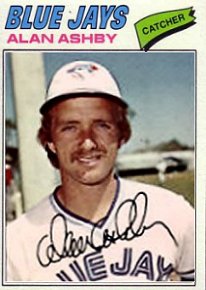 Ashby would go on to have a long and distinguished 17 year career in the biggs as a front line catcher. Unfortunately for the folks in Toronto only 2 of those seasons would be spent north of the border. Rescued from the death trap called the Cleveland Indians, Ashby was Toronto's starting catcher during his 2 seasons. He would play in 124 games and hit just .210 during the '77 season, but rebound in '78 for a .261 season with 9 homers. He was traded to Houston after that season for 3 useless players, which might make this the worst deal in Blue Jay history (at least to that point). This is his O Pee Chee card. The original Topps card had airbrushing that a 5 year old would not have been proud of.
 Lets just call Chuck Toronto's mystery man. After having a mediocre career as a mop up man during the mid to late 60's Chuck disappeared from baseball after the 1970 season. To say he disappeared would be a misnomer. From 1971-76 he spent time toiling in the minors hoping to find some trick pitch or spark to get him back to the majors. Call it his version of Leonard Nimoy's "In search of show". The only difference being that less people watched Chuck's show than Leonard's. Chuck was released by the White Sox, Giants and Padres during those years on the farm and each of those 3 franchises saw no reason to keep hold of a minor league pitcher who looked like John Saxon in a grade B movie. Hartenstein's final chance came with the Jays in '77. Here was his chance to show the world that a 35 year old pitcher with the best damn mutton chops this side of Neil Young could resurrect his mediocre career. What the Blue Jays got was a guy who lost 3 games in 17 relief appearances with a 6.59 ERA. Toronto would part company with the man known as "Twiggy" after the season. No more trips back to the minors would be made as this was Chuck's last stop in professional baseball. Topps issued a tight head shot card with a lot of airbrushing. I used his O Pee Chee card taken in spring training. Nothing says "cool" better than those mutton chops and the dark aviator glasses.
 A spot starter with little of no distinction in Detroit for 3 seasons made Lemancyzyk expendable. The Jays chose him in the expansion draft and he became the ace of their staff by posting a 13-16 record with a 4.25 ERA. Pretty impressive numbers for a starter on an expansion team who had to do battle with each team's ace. After taking a bit of a step back in '78 he rebounded to make the All-Star team in '79. In the middle of the 1980 season he was dealt to California for Ken Schrom. This is his O Pee Chee card taken in Spring Training. Topps issued a poor air brush card in '77.
 Ault will forever be in the Blue Jays record book for having hit the first home run in franchise history on opening day. Just to back it up he his a second homer later in the game. He would go on to hit 8 more that season as the Jays starting 1st baseman. His 64 RBI's were obviously a club rookie record that actually stood for 25 years. 1978 saw this promising rookie's numbers decline. '79 saw him head to the minors and when he returned in '80 he couldn't get back over the Mendoza line so he was cut. After his playing days ended he spent time coaching and managing in the minors. Sadly his life ended 3 days before Christmas in 2004 due to a self inflicted gun shot wound. Shown here is his O Pee Chee card. Topps issued a rookie panel card for him, so this is a huge step up from sharing space with 3 other rookies on cardboard.
 Woods was taken in the expansion draft from the Oakland A's organization. He appeared in the opening day lineup for Toronto, which left a lasting impression on him. That day there was actually snow on the field and Woods couldn't believe his eyes. He would play centerfield that season and hit .216 with no homers in over 220 AB's. He was quoted as saying, "I was a young guy who wasn't quite ready for the major leagues back then". Woods, obviously an analytical expert, went on to an average 6 year career in Houston and Chicago before he hung it up after the '85 season at the ripe old age of 30. His .377 average in 53 AB's helped the Astros in 1980 win the NL West down the stretch. He would never approach that type of meteoric success again. From 1981-85 he filled the roll of "4th outfielder" to perfection. This is his O Pee Chee Card from 1977. Topps issues a rookie panel card for him in '77 where he shared space with Steve Kemp and Tony Armas.
 As a 23 year old rookie in 1973 for the Brewers Pedro led the AL with 32 doubles, had 15 homers, 54 RBI's and hit a mean .245 all while manning the defense position at second base. BBWAA voters placed him second behind Al Bumbry for the Rookie of the Year voting. The possibilities were endless, or so everyone thought. Instead of improving Pedro's numbers declined year after year. The second time around the league they basically figure you out. Not being able to hit over .220 means you had better be a gold glover at your middle infield position, which he was not. Mid way through the '76 campaign he was dealt to Detroit, where he hit .198 and was left unprotected in he expansion draft. At 27 years of age he entered the 1977 season hoping to regain the form that he had 4 years earlier as a rookie. In 41 games he hit just .208 with absolutely no punch whatsoever and by July 27th he was given his outright release. The Padres signed him to a minor league contract, but he never again made it back up to the majors. This is a blurry version of his O Pee Chee card. Obviously Luis Tiant was a great influence on his facial hair design. Some say the fictitious SNL character, Chico Escuela, was based on him and partly on Felix Millan. After his rookie season baseball was definitely no "Berry Berry good to him".
 After 14 seasons in the big leagues as a "catch and throw" catcher, Phil was just hoping to hand on for another pay day. Those pay days would not last long. Roof would appear in just 3 games and log 5 hitless at bats before he was relegated to the role of "unofficial bullpen coach". At the end of the season he was given his release so he could head to San Diego to be their official bullpen coach. Topps did an ok job on their airbrush release, but since this would be Phil's final appearance on cardboard I decided to go with the O Pee Chee spring training photo card instead.
 A part time contributor on the Yankees '76 pennant winner, Velez was stuck behind a log jam of good outfielders in the Bronx. Toronto figured that by liberating him from his Bronx shackles he could be "the man" to build around. Velez responded with a .256 batting average in 120 games plus 16 round trippers. He would steadily improve his power numbers and average year in and year out culminating in his only 20 home run season in 1980. During that season he hit 4 homers in a double header. What was so special about that feat was the fact that he hit a solo shot, a 2 run shot, a 3 run shot and a grand slam. 1980 would be Velez' high water mark. By 1981 he would drop to .213 with only 11 homers. In '82 he would hit .193 in limited action and would be released by the Jays. In 6 years in Toronto he would hit .257 with 72 homers and 243 RBI's. Topps issued a horrendous close in head shot for his '77 card. Pictured here is his O Pee Chee card that looks 100 times better.